
Learn Languages Like the Pros with These 24 Principles
Have you ever experienced any of the following:
- You reached the end of your course and weren’t sure what you were supposed to do next?
- You felt like your course or activities weren’t effective but weren’t sure what to change?
- You did some research but encountered so many different techniques you weren’t sure whose advice to follow?
- Your progress started to slow and you weren’t sure why?
I’ve experienced all three, and my explorations as a beginner are what led me to write The Language Learner’s Handbook. I wanted to cut through the confusion and show beginners how they can easily start learning a language themselves. It’s more of a how-to, focused on key ideas and resources with only a minimum of theory.
But, I admit, there are gaps.
Once you get past the beginner stage, there is still the open question of what to do next, and there’s lots more to know about how to learn effectively. I told you what to do, but not how to do it best. That’s by design, I didn’t want to overwhelm everyone!
I still wanted to answer the question fully. How are you supposed to learn languages effectively?
That’s the purpose of my new book: The Principles of Language Learning.
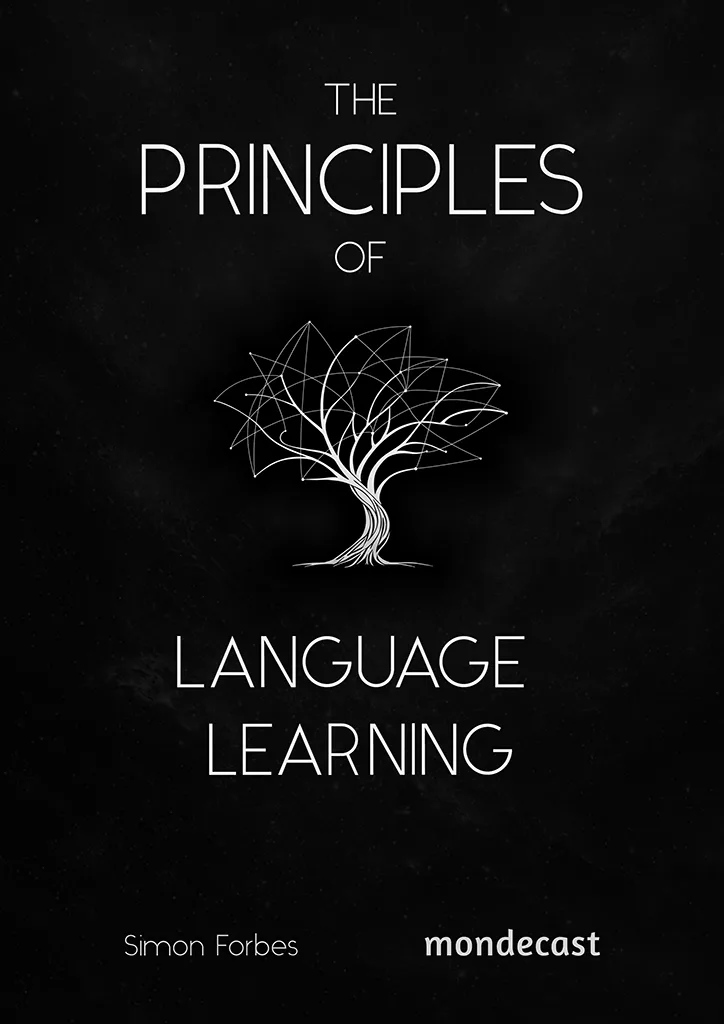
During my research, I found all sorts of different routines, resources, techniques, exercises. Which one was the right one for me? What about my readers?
It seemed like everyone was talking about what they were doing, but few could explain why they were doing it.
What to make of it all?
When I stood back and looked at the whole, I made a crucial discovery: underlying all these differences were hidden similarities. Though they utilised different techniques, underneath the surface they were all implicitly applying the same ideas.
These ideas are the essence of effective language learning.
So I set about writing them down systematically, and this book is the result. You see brief snapshots of a few of these in The Language Learner’s Handbook, but this is where we dive into them with enough depth to apply them consistently.
You don’t have to be a polyglot to learn languages like they do. As ordinary learners, we can take these ideas and apply them to our own languages, preferred activities, and routines to build something that is works for us and learn effectively.
This is not War and Peace. Each principle is designed to be easily digestible in a short sitting, where the focus is on density of information rather than packing it full of anecdotes for filler.
This book is a complement to the foundational knowledge you have learnt in The Language Learner’s Handbook. The Principles of Language Learning will explain the 24 core ideas that will make you an effective language learner. With them you will be able to evaluate methods for yourself, avoid dead ends, and make confident decisions about how you study to become a highly successful language learner.
You already know how to start, now learn how to think.
This guide will help you:
- Understand why techniques such as immersion work and when they don’t
- Separate useful effort from activity that only feels productive
- Build your own approach instead of copying someone else’s routine
- Use your memory effectively and learn quickly
This guide is for you if:
- You’ve already started learning a language and want to do it properly
- You’re tired of contradictory advice and want a coherent mental model
- You care more about long-term progress than quick wins
- You prefer understanding over blind repetition
You can get it from the Mondecast Store here or on Leanpub here.
You can download a sample with three principles from here. The full guide is a bit over 100 pages.