The 1000 sentence technique – how to close the gap between understanding and speaking
It’s a problem as old as language learning: you understand perfectly when you hear it, but the moment it comes to speaking, you stumble.
Was that the right word?
Oh, I was supposed to use the subjunctive there, wasn’t I?
That came out very stilted.
All common thoughts.
The typical way this is overcome is through lots of input combined with speaking practice. This absolutely works, but it does have its flaws:
- If you use slightly unnatural or incorrect forms and are understood, this reinforces your errors and it will be difficult to spot fix them later.
- Input builds broad understanding but is slow at making specific forms available for production.
- It takes a lot of input to learn forms well.
- The barrier to first starting speaking is quite large if you’ve never used the language productively before.
All this makes it a challenge to start using the language to communicate, something that is likely a core goal for almost everyone reading this.
The way I overcome these issues is by drilling hundreds of native-language first flashcards, something I call the 1,000 sentences technique. It works by maximising your production of key correct forms, committing them to memory and letting you communicate effectively and fluently sooner.
The technique
The technique looks similar to sentence mining (which uses sentences receptively), but the card order is reversed. The result is very different.
The key workflow is this:
- Identify grammatical features and patterns you want to have at hand. Don’t just think verb conjugations. Think ways of forming ideas that don’t follow your native-language patterns. Think words and usage that don’t directly translate.
- Find short sentences that use those features. Sentence fragments and phrases are fine. You can get them from dictionaries, specialised resources, or your input. Start simple and more common, then gradually expand their length and difficulty as your level improves.
- Add these sentences to Anki (or an equivalent) with your native language on the front, target language on the back.
- When reviewing, your goal is to get the entire sentence correct in your target language.
I recommend you build overlapping sentences. Each feature should appear across multiple sentences in different contexts. Make 2 or more sentences per form. By the second or third you should be finding the sentence noticeably easier. This allows you to create lots of cards as you move through them faster.
It is common to bold specific words and forms and mark yourself based on that only rather than the sentence. I recommend you mark yourself on the whole sentence. This is why smaller, simpler sentences are generally better.
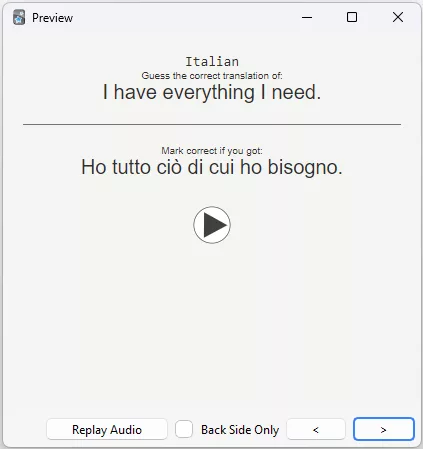
Make sure the sentences you save are natural to use in conversation. Sentences in flashcards are out of context, so you won’t be able to tell if something should be used only in literary contexts, for example. To ensure this, sentences taken from YouTube or podcast transcripts are very useful.
The basic ideas here (use flashcards and use output) are not new. I am packaging these ideas up into a technique you can implement for yourself.
Why this technique works
A while back, I wrote an article comparing connections in the brain to a garden path. Your map of your native language is like a garden path, with paths (grammar) connecting words (crossroads). Learning a new language is like overlaying a new path over the old. Without a clear path to follow, you quickly and unconsciously default to your native-language path.
It takes a lot of effort to build that new path and to force yourself away from your native language one.
The input-then-speaking model relies on the messy process of getting lots of input then gradually trying to create a new path yourself (practising speaking), usually without knowing quite where you are going.
The 1,000 sentences technique bridges that gap by grabbing your hand and showing you exactly where to go. It’s like a pre-speaking exercise, the key being that it forces correct output only.
With tens of sentences, you get a good feel for a few key scenarios. With hundreds, you unconsciously notice how the different paths you’ve been shown overlap, and you start to build a coherent map that lets you link them together in novel ways. That’s why you need overlapping sentences.
This technique builds the scaffolding: the core grammar, key connector words and common words, sayings, and phrases. These are things you always need, no matter the context you are communicating in.
Where it might take you hundreds of hours of reading before you catch that subjunctive form enough times to get it, 1,000 sentences makes sure it’s there for you when you need it.
Being graded on pre-written sentences also means there is no risk of reinforcing errors the way unguided conversation does. You’ll spend less time later correcting fossilised errors.
How to integrate it into your learning
No single technique or activity makes you fluent. 1,000 sentences is not a replacement for anything. It is a complement. Any effective method is a mix of activities.
Reaching an advanced level requires a very large amount of input, regardless of what technique you use. All users of this technique will eventually stop adding flashcards and move to input. Input is also important for helping you encounter new sentences to add.
While productive flashcards can be effective for learning words, they are slow and high effort. You learn fewer things, but you learn them very well. Building your skill through sentences is still going to take a while.
Because of this, you will still need to find a way to improve your vocabulary, be that through receptive (target-language first) flashcards or through input.
Finally, this technique does not replace practice; it enhances it. Ensure speaking practice is a part of your routine to turn the 1000-sentence knowledge into usable language.
Adapting the technique
There is no one perfect language learning technique, only principles that support effective learning. Beyond that, it’s learner enjoyment and aptitude that are key to learning.
Some things will make this type of activity less effective:
- If you are less concerned with communicating, or want to use a method that involves a very large silent period and a lot of input before ever attempting to communicate.
- If you feel bored or demotivated by flashcards or sentence learning.
- If you are enthusiastic about using input or traditional grammar study, and don’t mind taking longer before you are ready to speak.
This technique does not mean you have to spend hours every day drilling the minutiae of every grammar rule. Your goal is driven by your desires and priorities. 1,000 sentences is a technique for building towards your goals, not a goal in and of itself.
Aim for 1,000 and you’ll likely plateau somewhere between 300 and 1,000 depending on the language and your goals. You can always add more as you progress and discover a need.
What I’m doing with this
1,000 sentences has long been a core part of how I learn. I have a huge amount of sentences saved and it works.
What I haven’t yet done is commit 100% to a very large number.
In my next language learning journey, bringing my Italian to an advanced level, I intend to commit and see how far it takes me. I’ll be updating this post with my progress after that experiment is complete.
One Final thing
Learning a language takes sustained practice over a long period of time. If you’d like a little help staying motivated, consider my newsletter. Every second week I drop a little bit of motivation directly in your inbox through tips, resources, and anything else of interest. Don’t worry, I never spam, never share emails, and there’s an easy unsubscribe button if you decide it’s not for you. It’s completely free; no catch, no premium, just the best of what I can find on the internet. More info here.